

Revocable L/C and Irrevocable L/C: Procedures, Key Differences, and Critical Considerations for Import–Export Businesses
What Is a Revocable Letter of Credit (Revocable L/C)?

What Is a Revocable Letter of Credit (Revocable L/C)?
A Revocable Letter of Credit (Revocable L/C) is a type of letter of credit that the issuing bank may amend or cancel at any time, without prior notice and without the consent of the beneficiary (exporter).
In other words, even if the seller has already shipped the goods or fully prepared the required documents, the bank’s payment undertaking can still be withdrawn. In practice, Revocable L/Cs are only found in transactions with an exceptionally high level of trust—most commonly intra-group transactions.
Illustrative Example: A parent company in Vietnam issues a Revocable L/C to pay its subsidiary in China for imported components used in production. If the production plan changes or the order is adjusted or suspended, the parent company may request the bank to amend or cancel the L/C at any time, without causing major disputes, since both parties belong to the same corporate group and share common financial interests.
>> Read More: Letter of Credit (L/C): Definition, Types, Process, and Key Considerations in International Trade
This example highlights how the benefits and risks of a Revocable L/C are unevenly distributed between the parties.
For the Buyer (Importer):
Has the right to request the bank to cancel or amend the L/C in cases such as:
- Changes in market demand
- Adjustments to business or production plans
- Internal disputes or economic fluctuations
Reduces the pressure of payment commitments during periods of uncertainty.
For the Seller (Exporter):
- No firm guarantee of payment
- Even after goods are prepared or shipped, the L/C may still be canceled
- Extremely high financial risk if the transaction is not intra-group or lacks supplementary agreements
Due to this imbalance of interests, Revocable L/Cs are rarely used in standard international trade, especially in transactions between independent parties.
Revocable Letter of Credit (Revocable L/C) Procedure
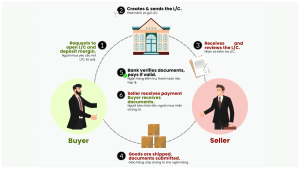
Revocable Letter of Credit (Revocable L/C) Procedure
1. Signing the Sales Contract
- Both parties agree to use a Revocable L/C as the payment method
- Typically applied to intra-group transactions or relationships based on exceptional trust
2. Importer Requests L/C Issuance
- The buyer requests the issuing bank to open a Revocable L/C
- The bank does not provide a fixed payment commitment
3. Issuing Bank Issues the L/C
- The L/C is issued and sent to the advising bank
- The exporter receives the L/C but without solid legal assurance
4. Exporter Prepares and Ships the Goods
- The seller manufactures, packs, and ships the goods according to the L/C
- Payment risk exists throughout this stage
5. L/C May Be Amended or Canceled
- Before documents are paid, the importer or bank may amend or cancel the L/C at any time
- No consent from the exporter is required
6. Presentation of Documents and Payment (If the L/C Remains Valid)
- Payment is made only if the L/C has not been canceled and the documents comply
- The exporter remains in a passive and vulnerable position
Key Point: The payment undertaking is unstable, with risks largely borne by the seller.
>> Read More: What is TTR Payment (Telegraphic Transfer Reimbursement)?
What Is an Irrevocable Letter of Credit (Irrevocable L/C)?

What Is an Irrevocable Letter of Credit (Irrevocable L/C)?
An Irrevocable Letter of Credit (Irrevocable L/C) is a letter of credit that cannot be amended or canceled without the consent of all involved parties, including:
- The importer
- The exporter (beneficiary)
- The issuing bank
Once validly issued, the issuing bank is obligated to make payment to the exporter provided that the presented documents fully comply with the L/C terms, regardless of the commercial relationship between buyer and seller.
Under current international practice (UCP 600), all Letters of Credit are deemed irrevocable by default, unless expressly stated otherwise.
Irrevocable Letter of Credit (Irrevocable L/C) Procedure
1. Signing the Sales Contract
- Both parties agree to use an Irrevocable L/C
- Key terms are defined: value, validity, required documents, and delivery conditions
2. Importer Requests L/C Issuance
- The buyer requests the issuing bank to open an Irrevocable L/C
- The bank accepts a conditional payment obligation
3. Issuing Bank Issues the L/C
- The L/C is issued and transmitted to the advising bank
- The exporter receives the L/C with a solid legal basis to proceed
4. Exporter Ships the Goods
- Goods are produced, packed, and shipped strictly in accordance with the L/C
- The exporter proactively prepares compliant documents
5. Presentation of Documents
- The exporter submits the document set to the advising or nominated bank
- Banks examine document compliance only, not the actual goods
6. Payment
- If documents comply, the issuing bank is legally bound to make payment
- Payment is independent of the importer’s financial condition
Key Point: The payment commitment is legally binding, and risks are effectively controlled.
Revocable L/C vs. Irrevocable L/C: Key Differences
| Criteria | Revocable L/C | Irrevocable L/C |
| Right to amend/cancel | At any time | Only with all parties’ consent |
| Bank commitment | Uncertain | Legally binding |
| Risk to exporter | Very high | Low |
| Practical usage | Almost obsolete | Globally standard |
According to current international practice, most Letters of Credit issued today are irrevocable by default.
Logistics & Trade Documentation Solutions from King Freight Logistics Vietnam (KFLV)

In practice, the greatest risks associated with Letters of Credit do not lie with the banks, but with how businesses choose the L/C type and control their documentation. Using the wrong type of L/C, preparing Commercial Invoices, Packing Lists, or Bills of Lading that are inconsistent with L/C terms, or failing to properly assess the level of bank commitment can result in delayed payments, refusal of payment, or disputes.
King Freight Logistics Vietnam (KFLV) partners with import–export businesses to manage payment and logistics risks from the very beginning of each transaction.
KFLV supports businesses by:
- Advising on the appropriate type of L/C for each market and trading partner
- Reviewing and controlling L/C documents, Commercial Invoices, Packing Lists, and Certificates of Origin (C/O)
- Providing international FCL & LCL transportation with stable schedules
- Supporting customs clearance procedures for various cargo categories
- Optimizing logistics costs and minimizing storage and demurrage charges
Hotline: +84 (0) 938 188 796
Email: cs1@hcm.kfkingfreight.com
Contact us today for a comprehensive logistics and documentation solution, helping your business ship with confidence, control payment risks, and comply fully with international trade practices.
Written bykflv.vn
Other activities

Other news
What is a Surrendered Bill of Lading? When Should It Be Used in International Trade? In international shipping, a Bill of Lading (B/L) is not only a transport document but can also function as a document of title to the cargo. However, in many cases businesses do not need this ownership function and choose to […]