

What is a Surrendered Bill of Lading? Telex Release Process and Important Notes
What is a Surrendered Bill of Lading? When Should It Be Used in International Trade?
In international shipping, a Bill of Lading (B/L) is not only a transport document but can also function as a document of title to the cargo. However, in many cases businesses do not need this ownership function and choose to use a Surrendered Bill of Lading to shorten the cargo release process.
So what is a Surrendered B/L, how does the process work, and when should it be used? The article below helps businesses understand the concept clearly in order to select the appropriate type of bill of lading.
>> Read More: Bill of Lading (B/L) and Sea Waybill
What is a Surrendered Bill of Lading?
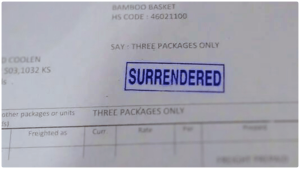
What is a Surrendered Bill of Lading?
A Surrendered Bill of Lading (Surrendered B/L) is a type of bill of lading in which the shipper submits all original copies to the shipping line at the port of loading, and requests the carrier to send a telex release to its agent at the destination port to release the cargo.
This means the consignee does not need to present the original bill of lading when collecting the cargo.
From a legal perspective:
- A Surrendered B/L has no negotiable value
- It cannot be used as a document of title
- It mainly serves as confirmation from the carrier that the cargo can be released to the consignee
This type of bill of lading is commonly used in the following situations:
- Internal transactions between parent and subsidiary companies
- Processing or contract manufacturing arrangements
- Long-term and trusted commercial relationships
- Shipments that have already been fully paid
When Should a Surrendered B/L Be Used?
A Surrendered Bill of Lading is usually chosen by businesses in the following situations.
No need for negotiable bill of lading functions
An Original Bill of Lading can be used to buy, sell, or transfer ownership of cargo. However, if the consignee is clearly identified and there is no need to transfer the cargo to a third party, businesses may choose a Surrendered B/L.
The consignee needs to receive cargo quickly
On many short shipping routes (such as intra-Asia routes), vessels may arrive at the destination before the original documents reach the importer. In this case, using a Surrendered B/L helps avoid delays in cargo release.
To avoid the risk of losing original documents
Original bills of lading are usually sent via international courier. If the documents are lost, it can take significant time to resolve the issue. A Surrendered B/L helps eliminate this risk.
High level of trust between both parties
Since cargo can be released without presenting the original B/L, this method should only be used when the trading relationship is stable or payment has already been completed.
>> Read More: Safe Packaging Standards for Goods in Transportation
Relationship Between Surrendered B/L and Telex Release
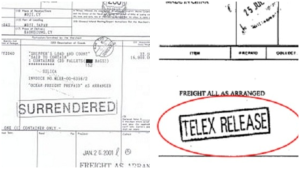
Relationship Between Surrendered B/L and Telex Release
In practice, Surrendered B/L and Telex Release always go together.
What is a Surrendered B/L?
It is a bill of lading where the shipper has returned the original B/L and the carrier confirms that the original bill of lading has been surrendered and canceled.
What is a Telex Release?
A Telex Release is an internal notification from the shipping line sent to its agent at the destination port, confirming that the cargo can be released to the consignee without requiring the original bill of lading.
After the telex release is sent:
- The shipping line’s agent at the destination port can proceed with cargo delivery
- The consignee only needs to complete the required procedures at the port to collect the container
As a result, the cargo release process can be significantly faster.
>> Read More: Cargo Insurance Conditions for Import and Export (Updated to ICC 2009)
Process for Issuing a Surrendered Bill of Lading
Depending on when the request is made, the process may vary.
Original B/L Has Already Been Issued
In many situations, the original bill of lading has already been issued but cannot be delivered to the importer before the vessel arrives at the destination port. In this case, businesses may request to convert it into a Surrendered B/L.
The process is as follows.
Step 1: The shipper submits all original bills of lading (usually three original copies) to the shipping line or freight forwarder.
Step 2: Request the carrier to issue a Surrendered B/L and perform a Telex Release.
Step 3: Pay the fee for converting to a Surrendered B/L. The cost is usually around USD 30 – 50, depending on the shipping line.
Step 4: After confirming the return of the original B/L, the shipping line will cancel the original B/L and issue a Surrendered B/L, usually in the form of a scanned copy stamped “SURRENDERED”.
Step 5: The carrier sends the telex release to its agent at the destination port.
Step 6: When the cargo arrives, the consignee only needs to complete the procedures with the shipping line to collect the cargo.
Note:
In this situation, businesses may incur two separate charges:
- Original B/L issuance fee
- Surrendered B/L conversion fee
Original B/L Has Not Been Issued
If both parties agree from the beginning to use a Surrendered B/L, the process becomes simpler.
The steps are as follows.
Step 1: The shipper requests the carrier to issue a Surrendered B/L directly instead of an Original B/L.
Step 2: Pay the telex release fee to the shipping line (usually around USD 30 – 50).
Step 3: The shipping line sends the telex release to its agent at the destination port.
Step 4: The consignee completes the cargo release procedures without presenting the original bill of lading.
This approach helps:
- Reduce the risk of document loss
- Save time in sending original bills of lading
- Speed up cargo release at the destination port
>> Read More: What is a Shipping Instruction (SI)?
Important Notes When Using a Surrendered B/L
Although convenient, businesses should still consider several risks when using this type of bill of lading.
No negotiable value
A Surrendered B/L is only used for cargo release. It cannot be bought, sold, pledged, or transferred like an Original Bill of Lading.
Only use with trusted partners
Since cargo can be released without the original B/L, if the importer fails to make payment as agreed, the exporter may face difficulties controlling the cargo.
Not suitable for L/C payment
In transactions using a Letter of Credit (L/C), banks usually require the Original Bill of Lading for document presentation and payment. Therefore, Surrendered B/L is generally not accepted under this payment method.
Confirm the Telex Release with the carrier
A Surrendered B/L is only effective once the shipping line has sent the telex release to its agent at the destination port.
Check the shipping line’s requirements
Some shipping lines require all three original bills of lading to be returned, while others may have more flexible procedures.
A Surrendered Bill of Lading is an effective solution to shorten cargo release time and reduce the risk of document loss in international shipping. However, businesses should fully understand the process and only use this method when the commercial relationship is reliable and the negotiable function of the original bill of lading is not required. Choosing the appropriate type of bill of lading from the beginning can help businesses avoid unnecessary costs, prevent delays in cargo release, and optimize international logistics operations.
Supporting Businesses with B/L
Supporting Businesses with B/L
At King Freight Logistics Vietnam (KFLV), we support businesses in selecting the appropriate type of bill of lading and handling Surrendered Bill of Lading (Telex Release) procedures efficiently, ensuring cargo can be released smoothly when the vessel arrives.
Our KFLV team has experience in:
- Advising whether to use Original B/L or Surrendered B/L based on payment terms, Incoterms, and the level of trust between trading parties
- Checking and handling the surrender process of original bills of lading to ensure proper issuance by the shipping line
- Monitoring telex release notifications from the carrier to the destination agent to minimize cargo release delays
- Coordinating with shipping lines, destination agents, and trucking providers to ensure the consignee receives cargo on time
- Advising on documentation procedures to avoid container detention and demurrage (D&D) charges when cargo arrives before documents
If your business needs international shipping services and wants to handle Surrendered B/L or Telex Release procedures correctly to avoid cargo release delays, please contact KFLV at +84 (0) 938 188 796 or cs1@hcm.kfkingfreight.com for detailed support from our team.
Written bykflv.vn
Other activities


Other news
What Is a Revocable Letter of Credit (Revocable L/C)? A Revocable Letter of Credit (Revocable L/C) is a type of letter of credit that the issuing bank may amend or cancel at any time, without prior notice and without the consent of the beneficiary (exporter). In other words, even if the seller has already shipped […]