

What is a Barge? Types of Barges in Freight Transportation
What is a Barge?
A barge is a long, flat-bottomed boat designed to carry freight along rivers and in ports. Typically, barges are unpowered and require tugboats for movement, though some self-propelled barges do exist. Ranging in size, the most common length is 300 feet, capable of transporting up to 8,000 MT of cargo. Smaller barges, while less common, offer greater access to various waterways.
Is a Barge Different from a Ship?
Yes, barges are flat-bottomed and primarily used for transporting goods, unlike ships that may carry both goods and passengers. Most barges are not self-propelled, whereas ships generally are. Additionally, barges are typically found on inland waterways and ports rather than the open ocean.
Types of Barges
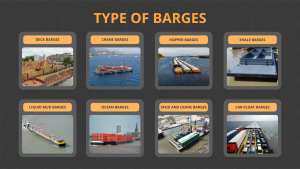
Types of Barges
Inland Barges
Inland barges operate on rivers and inland waterways. They are highly economical for transporting oversized and high-density cargo, making them essential for businesses with significant freight needs. These barges can vary widely in design and capacity, tailored to handle different types of cargo effectively.
Deck Barges
Deck barges feature open decks designed to carry cargo directly on top, unlike hopper or shale barges that transport goods within covered spaces. They come in various sizes and shapes, often custom-built for specific tasks. Besides transporting goods, deck barges serve as versatile work platforms for machinery and personnel engaged in marine projects.
Crane Barges
Crane barges are equipped with cranes for offshore construction and other heavy lifting tasks. Unlike most other barges, crane barges are often self-propelled, allowing them to operate in open seas without towage. They are crucial for tasks such as dredging, marine salvage, and installing offshore infrastructure.
Hopper Barges
Hopper barges are designed to carry bulk materials like coal, grain, and ore. They feature large hoppers with doors that open downward for unloading. Some hopper barges are split-hull designs, where the hull itself opens to release cargo. These barges are double-hulled for safety and may have removable covers to protect their cargo.
Shale Barges
Integral to the oil drilling industry, shale barges transport liquid and solid waste produced during drilling. These barges come in various sizes and can handle large volumes of waste, which is transported to processing facilities for safe disposal. Shale barges can be either hopper or deck barges, depending on their specific design and use.
Liquid Mud Barges
Liquid mud barges are specialized for transporting drilling mud from oil wells. They feature piping and pumping systems for efficient loading and unloading. These barges typically have multiple compartments and can transport significant volumes of mud, ensuring the safe and regulated handling of this material.
Ocean Barges
Ocean barges are designed for coastal and nearshore operations, capable of carrying heavy and high-volume cargo. They are built with robust construction to withstand ocean conditions but are slower than ocean freighters. Ocean barges are essential for ports with shallow depths or restricted access that larger ships cannot reach.
Spud and Crane Barges
Spud barges, or jack-up barges, use steel shafts (spuds) to anchor to the seabed, providing stability for construction and demolition projects. These barges often house cranes for lifting operations and are ideal for tasks requiring a steady platform, such as pile driving and marine infrastructure installation.
Car-Float Barges
Car-float barges are equipped with railway tracks, enabling the transportation of railroad cars across water bodies. These barges are loaded using specialized ferry slips that adjust to water levels. Unlike train ferries, car-float barges are flat-bottomed and operate only on inland waterways, providing a crucial link in multi-modal transport systems.
Shipping Solutions with KFLV
King Freight Logistics Vietnam (KFLV) provides comprehensive shipping services with:
- Flexible transport options: Air and sea freight services.
- Customs clearance support: Minimizing delays and risks.
- Cost-optimized solutions: Catering to both small and large shipment volumes.
- Expert consulting team: Assisting businesses throughout the entire export process.
With years of experience and an extensive logistics network, KFLV is a trusted partner for businesses looking to transport goods by railway quickly, safely, and cost-effectively.
Contact us today at +84 (0) 938 188 796 for consultation and a detailed quotation!


Written bykflv.vn
Other activities

Other news
What is a Surrendered Bill of Lading? When Should It Be Used in International Trade? In international shipping, a Bill of Lading (B/L) is not only a transport document but can also function as a document of title to the cargo. However, in many cases businesses do not need this ownership function and choose to […]