What Is ISPM 15?

What Is ISPM 15?
ISPM 15 (International Standards for Phytosanitary Measures No. 15) is an international regulation issued by the IPPC to prevent the spread of pests through wood packaging materials used in global trade.
It defines approved treatment methods — mainly Heat Treatment (HT) or Methyl Bromide (MB) — to ensure that pallets, wooden crates, dunnage, and wooden supports are free from insects and harmful microorganisms.
Which materials require ISPM 15 treatment?
- Natural wood pallets (softwood / hardwood)
- Wooden crates, boxes, and packaging
- Dunnage and wooden blocks inside containers (often overlooked by shippers)
ISPM 15 exemptions
The following engineered wood materials are exempt because they are processed at high temperatures and pressures:
- MDF
- Plywood
- OSB
- Laminated / composite wood
However, some countries still require supporting certification if these materials are used as pallet replacements.
>> Read More: What is a Pallet
Why Must Export Pallets Comply with ISPM 15?
Key benefits for exporters
- Smooth customs clearance worldwide — mandatory in the US, EU, Japan, Australia, and Canada.
- Lower risk of rejection or re-inspection, reducing delays and extra costs.
- Improved credibility when working with international partners.
- More stable supply chains by avoiding shipment delays caused by quarantine issues.
What happens if pallets do NOT meet ISPM 15?
- Cargo may be denied entry at the port.
- Additional costs for on-site fumigation or pallet replacement (often very expensive).
- Late deliveries and contract penalties.
- Loss of trust from overseas customers.
- Some countries (especially Australia & New Zealand) may order pallet destruction at the port.
Approved ISPM 15 Wood Treatment Methods
Approved ISPM 15 Wood Treatment Methods
To meet ISPM 15 requirements, wood packaging (pallets, crates, dunnage) must undergo one of the officially recognized IPPC treatments:
Heat Treatment (HT)
- Process: The core of the wood must reach 56°C for at least 30 consecutive minutes.
- Usage: The most widely accepted method globally (US, EU, Japan, Korea, China, Australia).
Advantages:
- Chemical-free and environmentally friendly.
- Accepted in nearly all markets.
Limitations:
- Requires heavy investment in kiln systems.
- Processing time depends on wood thickness and pallet volume.
Methyl Bromide Fumigation (MB)
- Process: Pallets are placed in an airtight chamber and fumigated with Methyl Bromide gas according to ISPM 15 dosage and exposure requirements.
- Usage: Still used for urgent shipments requiring fast processing.
Advantages:
- Can treat large quantities in one cycle.
- Faster than HT for time-sensitive shipments.
Limitations:
- Methyl Bromide is restricted in many countries (EU, Australia, New Zealand) due to environmental impact.
- Requires strict safety controls and ventilation.
- Many markets are gradually reducing acceptance of MB.
Dielectric Heating (DH)
Recognized in recent ISPM 15 revisions as a modern treatment method.
- Process: Uses high-frequency electromagnetic energy (radio frequency or microwave) to heat wood from the inside out, killing pests and microorganisms.
- Nature: Still a form of heat treatment, but faster and more uniform compared to traditional kilns.
Advantages:
- Very fast processing, especially effective for high-moisture wood.
- Precise and uniform core temperature control.
- Suitable for automated, high-tech production facilities.
Limitations:
- High initial equipment cost.
- Not widely available; fewer suppliers offer DH.
- Most exporters will still encounter HT more commonly in practice.
ISPM 15 Marking Requirements
ISPM 15 Marking Requirements
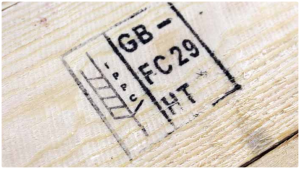
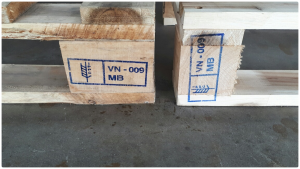
A compliant pallet must display the IPPC mark, which includes:
- IPPC wheat symbol
- Country code (Ex: VN for Vietnam)
- Unique manufacturer/treatment code
- Treatment method — HT, MB, or DH
Requirements:
- The mark must be clear, permanent, and placed on at least two opposite sides of the pallet.
- Companies cannot add logos or additional markings inside the IPPC stamp.
ISPM 15 Requirements by Major Markets
United States – EU – Canada
- Accept HT and MB.
- Incorrect or unclear markings → cargo may be held, fumigated, or rejected.
>> Read More: Export Standards & Procedures for Garments to the U.S. and Global Markets
China
- Strict inspection of moldy, wet, or damaged pallets.
- May require fumigation on arrival if the stamp is unclear.
>> Read More: Customs Declaration & Documentation Guide for Exporting Metal Molds to China (Dongguan)
Australia – New Zealand (strictest in the world)
- Prefer new, clean, mold-free pallets.
- Strong restrictions on MB.
- Reused pallets are often rejected.
Japan – South Korea – Taiwan
- HT is widely accepted.
- Pallets must be clean, dry, and free from soil or oil stains.
>> Read More: Xuất khẩu gỗ và đồ nội thất gỗ Việt Nam sang Đài Loan Exporting Wood and Wooden Furniture from Vietnam to Taiwan
Common Risks Exporters Frequently Encounter
- Faded or incomplete ISPM 15 stamps → cargo held for inspection.
- Reused pallets with outdated or invalid markings.
- Pallets treated correctly but stored in humid conditions, causing mold.
- Wooden dunnage not treated or missing IPPC markings.
- LCL shipments: one non-compliant shipment can trigger inspection for the entire container.
ISPM 15 Usage in Vietnam
In key export regions such as Ho Chi Minh City, Binh Duong, Dong Nai, and Haiphong, over 80% of export cargo uses ISPM 15-compliant pallets.
Industries with highest usage:
- Electronics & components
- Garments & footwear
- Furniture & wood products
- Coffee, cashew, pepper, fruit
- Processed food
Most major markets enforce ISPM 15, so exporters must carefully verify pallet compliance before shipment.
Why ISPM 15 Is the “Safety Key” for Global Shipments
ISPM 15 is not just a regulatory requirement — it is a critical safeguard that ensures export cargo moves safely, on time, and without costly disruptions.
Compliant exporters benefit from:
- Lower logistics costs
- Reduced quarantine incidents
- Stronger trust with international buyers
- More stable and predictable supply chains
FAQ – Common ISPM 15 Questions from Exporters
1. What is ISPM 15?
The global phytosanitary standard for wood packaging used in international shipments.
2. How do HT and MB differ?
HT is environmentally friendly and widely accepted; MB is cheaper and faster but restricted in many regions.
3. How do I know if a pallet meets ISPM 15?
It must carry a valid IPPC stamp and come with proper treatment certification.
4. Do reused pallets need to be treated again?
Yes — they must be re-treated and re-stamped before export.
5. What happens if pallets don’t comply?
Cargo may be held, re-fumigated, rejected, or incur additional storage costs.
Fast International Cargo Transportation Services
Compliance with ISPM 15 is not only a phytosanitary requirement, but a key factor helping exporters avoid cargo holds, fumigation costs, missed sailings, and loss of credibility with partners. Just one pallet with an unclear mark, one untreated wood dunnage piece, or a reused pallet that does not meet standards can result in the entire shipment being cross-inspected or denied entry.
King Freight Logistics Vietnam (KFLV) provides fast international cargo transportation services, while supporting businesses in end-to-end cargo control, ensuring shipments move in compliance, on schedule, and to the right markets:
- Advising optimal transport routes to the U.S., EU, Australia/New Zealand, Japan, Korea, China, and more.
- Supporting the selection of appropriate treatment methods (HT / MB / DH) before stuffing.
- Coordinating with compliant pallet suppliers to minimize risks of unclear marks, incorrect stamps, or non-compliant recycled pallets.
- Supporting early handling of quarantine risks to avoid re-fumigation or additional costs at destination ports.
Hotline: +84 (0) 938 188 796
Email: cs1@hcm.kfkingfreight.com
KFLV accompanies businesses in every export shipment — delivering fast transportation and ensuring stable customs clearance across international markets.