

Cut-off Time (Closing Time) in Logistics and Export-Import – Complete Explanation
What Is Cut-off Time (Closing Time)?

What Is Cut-off Time (Closing Time)?
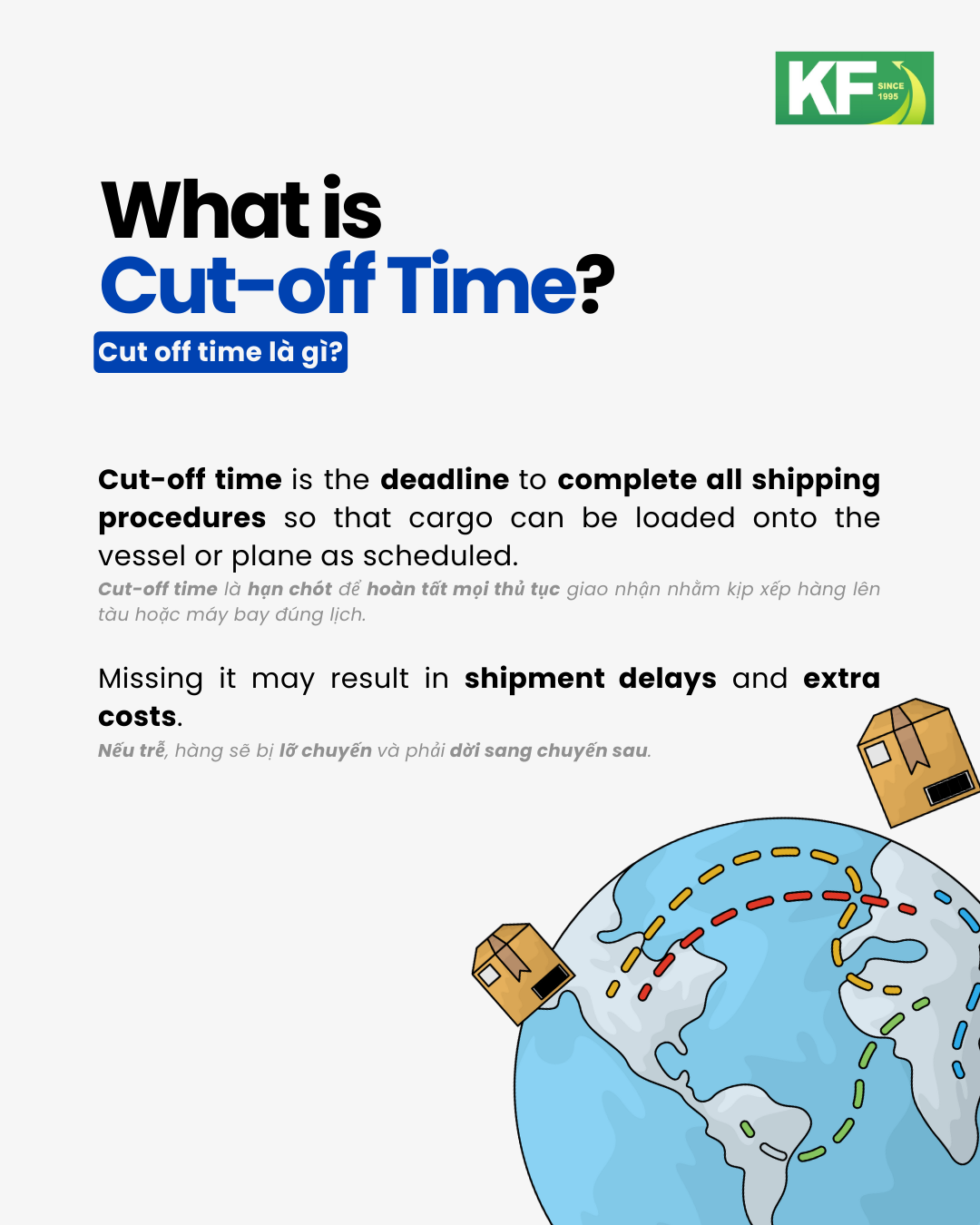
Cut-off time (also known as closing time, deadtime, or lead time) refers to the final deadline by which exporters must complete customs clearance, container gate-in, and all necessary procedures for the shipment to be loaded onto the vessel.
In Vietnamese, this term is commonly called “thời gian cắt máng” — meaning the last moment before “missing the vessel.”
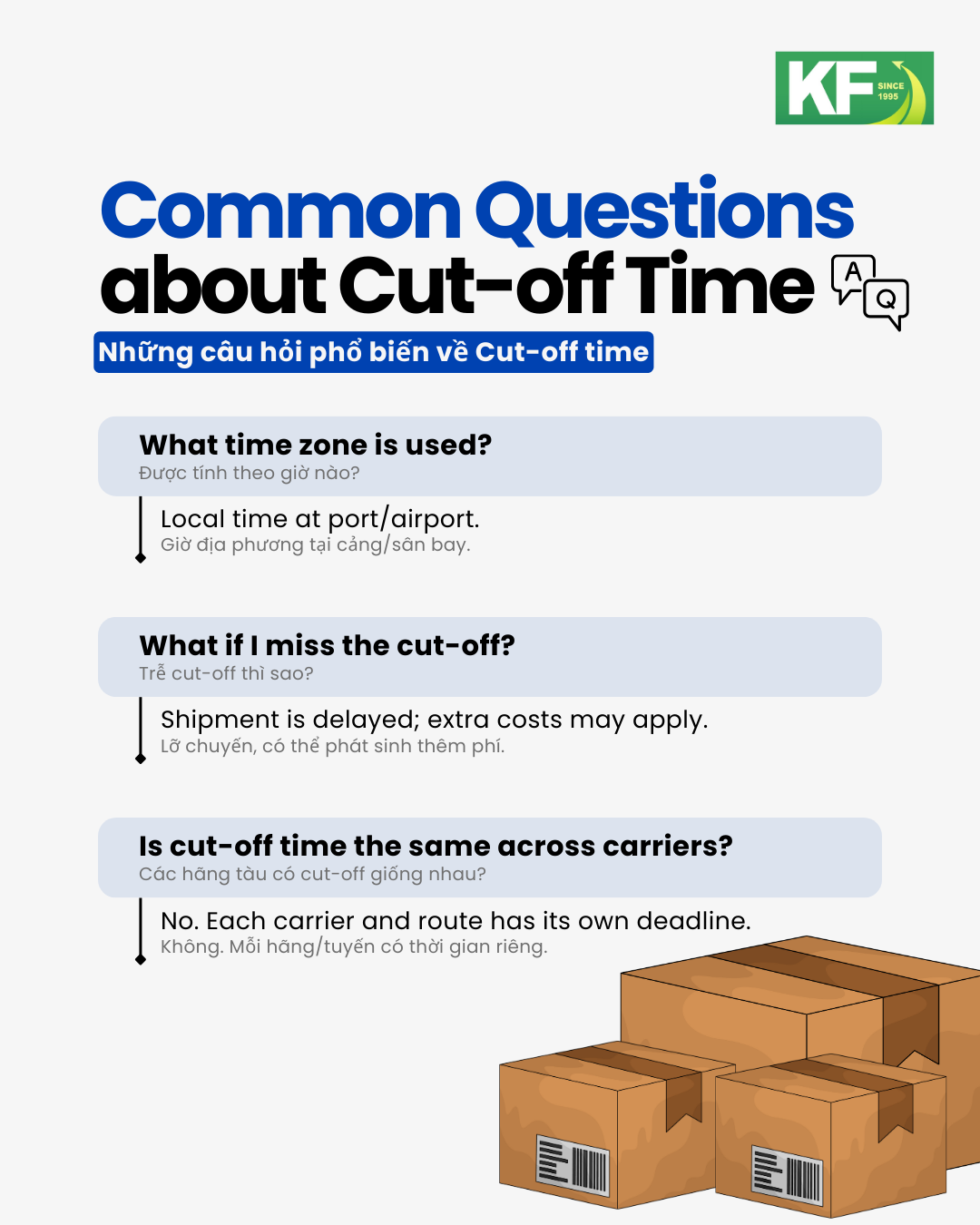
If the exporter fails to meet this deadline, the shipment will not be accepted and must be rescheduled for the next available vessel.
Cut-off time is a critical factor in the international shipping process, as it directly affects the vessel schedule, storage cost, and the on-time delivery of goods.
Key Stakeholders Involved in Cut-off Time
To understand how cut-off time works in logistics, it’s essential to recognize the roles of each stakeholder involved:
- Exporter (Shipper): The party shipping goods abroad.
- Importer (Buyer): The party purchasing and receiving goods.
- Shipping Line: Responsible for vessel schedules, container allocation, and transport.
- Customs (Export & Import): Handles cargo clearance at both ends.
- Port Authority: Manages terminal operations and authorizes loading at ports.
- Freight Forwarder: Acts as intermediary — arranges bookings, prepares documentation, and negotiates cut-off extensions when necessary.
- Insurance Company: Covers potential transport risks.
- Inland Transport Providers (Truck/Rail): Move cargo from factory or warehouse to port and vice versa.
>> Read More: What is Less Than Truckload (LTL)? Road Freight for LCL Shipments
Regulations and Requirements of Cut-off Time
Each shipping line sets specific cut-off times for every vessel departure — defining the latest submission of shipping instructions (SI), customs declaration, and container yard entry.
- If exporters miss the cut-off time, the shipment will miss the vessel and be rolled over to the next schedule (typically one week later).
- Some forwarders may negotiate a 3–6-hour extension based on their relationship with the carrier.
- In special cases, an official “Deadtime Extension Request Form” may be submitted and approved by both the carrier and terminal authority.
Exporters should also be aware of “Free Time”, the period during which containers can be used without incurring DEM/DET charges (demurrage or detention). This time frame is limited and varies by carrier policy.
The Container Handling Process Around Cut-off Time
The container handling process typically revolves around the cut-off timeline and includes eight key steps:
- Request quotation and booking: Confirm shipment details, cargo dimensions, and delivery deadlines.
- Prepare documentation: Packing list, commercial invoice, Certificate of Origin (C/O), and other required papers.
- Confirm shipment details with the forwarder or shipping line.
- Official booking confirmation for the selected vessel.
- Track shipment progress via the carrier’s online system.
- Complete export customs clearance at the port.
- Settle customs duties and related fees.
- Deliver and complete cargo handover.
>> Read More: FCL and LCL Shipping to Taiwan by Ocean Freight
What To Do If You Miss the Cut-off Time
Missing the closing time is not uncommon in export operations. In such cases, the exporter should:
- Immediately contact the forwarder, who can coordinate with the shipping line’s Sales or OPS team to request an extension.
- Submit a “Deadtime Extension Form” signed and stamped by the carrier and submit it to the terminal office for approval.
- If the request is denied, the booking will be rolled over to the next sailing, and the carrier will notify the shipper to reconfirm or cancel.
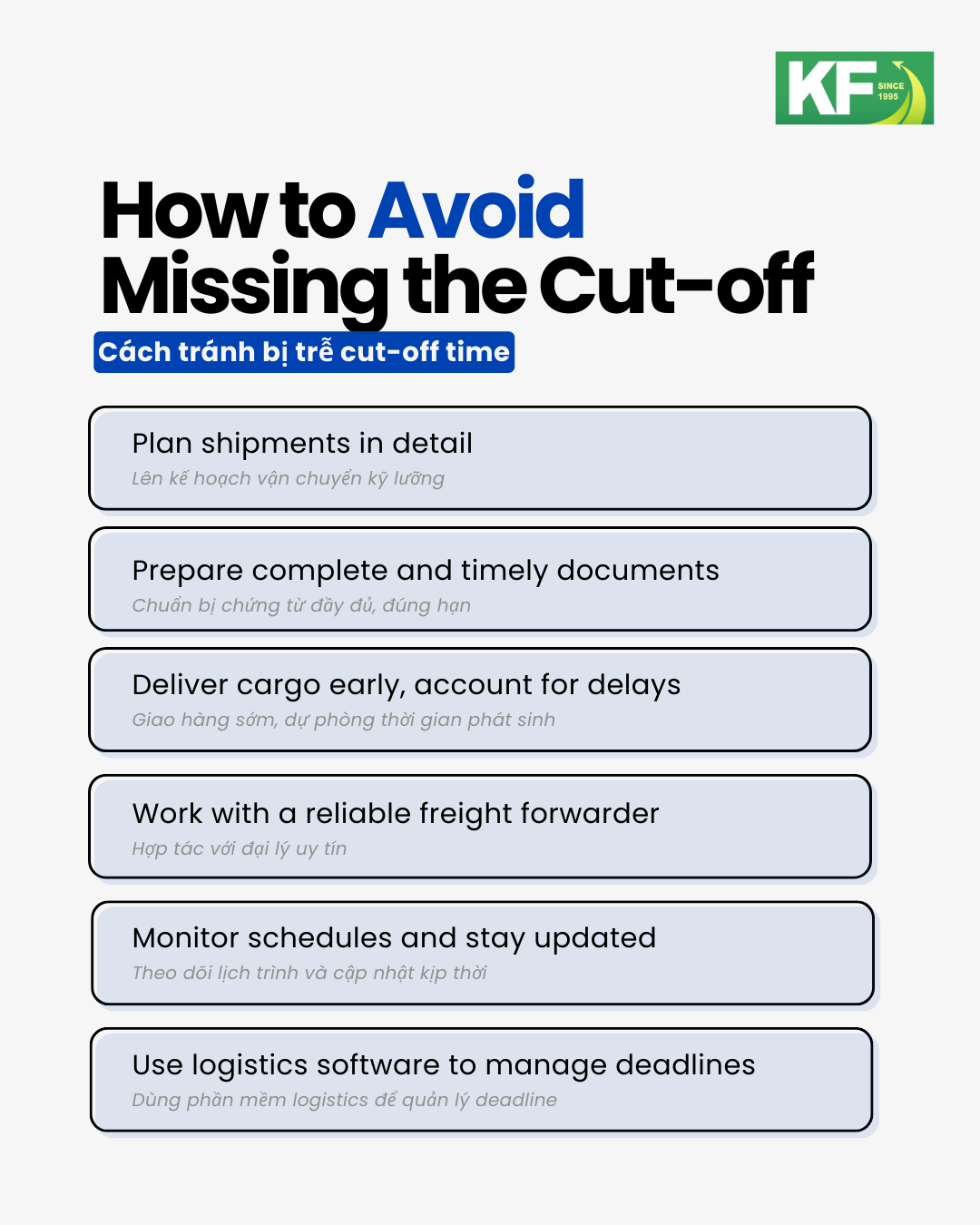
Partnering with a reliable forwarder is crucial to avoid vessel rollovers and minimize additional storage or demurrage costs.
Common Types of Cut-off in Logistics
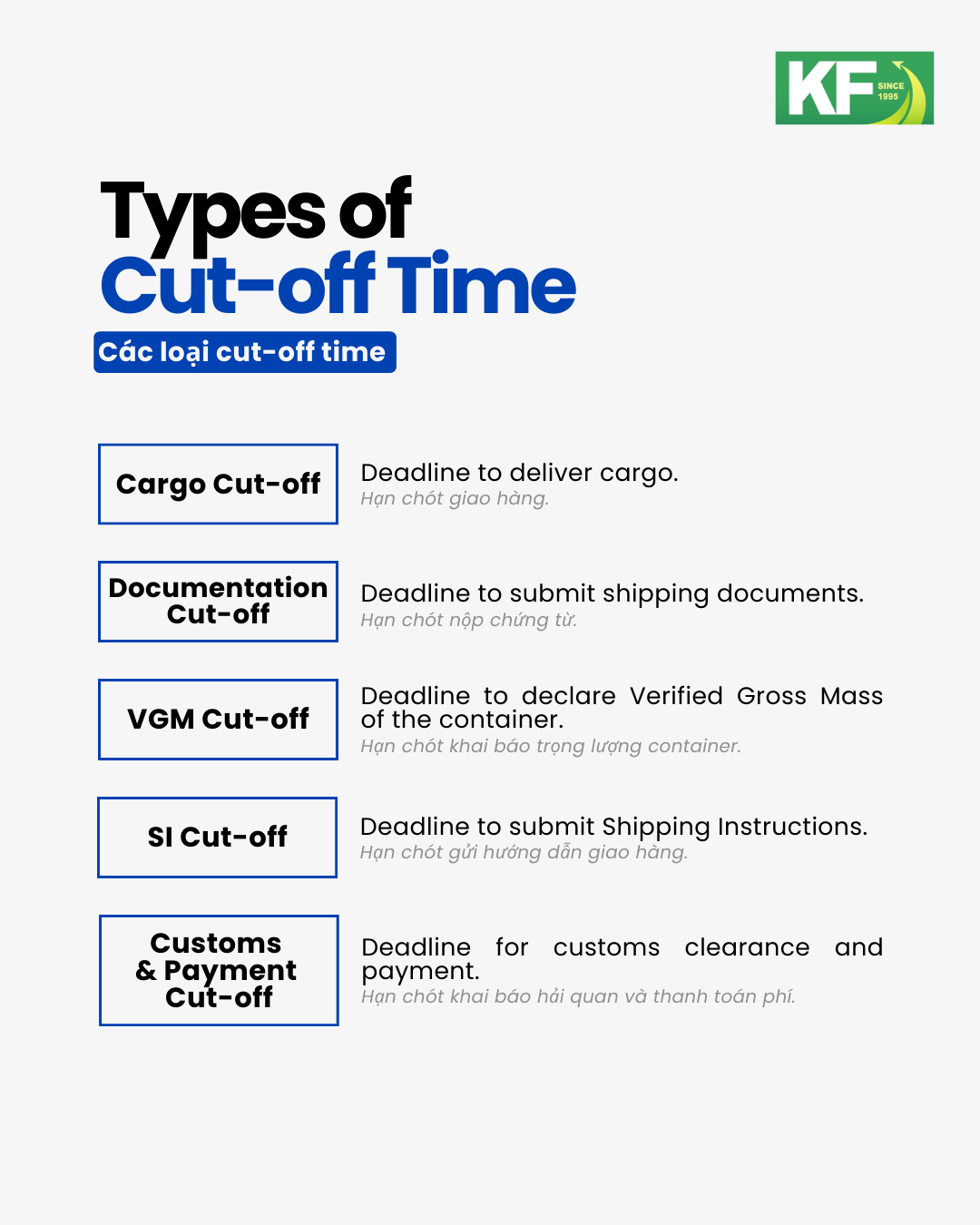
1. S/I Cut-off (Shipping Instruction Cut-off)
The deadline for submitting shipping instruction details to the carrier for Bill of Lading (B/L) issuance.
If missed, the carrier cannot issue the B/L in time, and the shipment will not be loaded.
Typically set 1–3 days before vessel departure, depending on the carrier.
2. C/Y Cut-off (Container Yard Cut-off)
The final gate-in time for containers at the port yard.
Exporters must complete customs clearance and deliver containers before this deadline.
This is often considered the most critical cut-off in sea freight operations.
3. DOC Cut-off (Document Cut-off)
The final deadline to confirm the draft B/L with the carrier.
If missed, the carrier will issue the B/L based on the submitted S/I details — and any post-issuance changes will incur B/L am endment fees.
4. VGM Cut-off (Verified Gross Mass Cut-off)
The deadline for submitting the container weight declaration (VGM) in compliance with SOLAS regulations.
Failure to submit VGM on time means the container cannot be loaded due to safety requirements.
5. CFS Cut-off (Container Freight Station Cut-off)
Applicable to LCL (Less than Container Load) shipments.
This marks the final delivery time for cargo to the CFS warehouse for consolidation.
Late deliveries will result in the cargo being moved to the next available container.
Why Cut-off Time Matters in Export-Import
Understanding and adhering to cut-off times helps exporters:
- Avoid missing vessel schedules.
- Reduce storage and container detention costs.
- Maintain reliable international delivery timelines.
- Strengthen credibility with import partners.
- Improve logistics planning and operational efficiency.
Cut-off time is not just a procedural deadline — it’s a strategic control point in global logistics.
By mastering different cut-off types (S/I, C/Y, DOC, VGM, CFS) and staying proactive, businesses can prevent disruptions and optimize shipping performance.
Cut-off Time Management & Handling Service

Cut-off Time Management & Handling Service
Meeting the cut-off time is more than a logistics requirement — it’s a strategic safeguard that helps exporters maintain schedule integrity, reduce vessel rollovers, and optimize overall transport costs.
Even minor mistakes — such as late SI submission, missed C/Y cut-off, or unreported VGM — can cause shipment delays, container storage fees, and supply chain interruptions.
King Freight Logistics Vietnam (KFLV) provides a comprehensive Cut-off Time Management Service, empowering exporters to stay in control of their shipments at every stage:
- Real-time monitoring & cut-off reminders (S/I, VGM, DOC, C/Y, CFS) by vessel and carrier.
- Export scheduling consultation to ensure readiness before each cut-off deadline.
- Cut-off extension support, working directly with carriers and port authorities when unexpected delays occur.
- Minimized demurrage and detention costs, ensuring faster, more efficient shipment handling.
Contact us: +84 (0) 938 188 796
Email: cs1@hcm.kfkingfreight.com
The KFLV team is ready to assist your business in every export step —
ensuring on-time cut-off compliance, smooth shipping schedules, and long-term reliability across all your international shipments.
Written bykflv.vn
Other activities


Other news

Overview of Vietnam–China Trade in 2025 In 2025, trade between Vietnam and China continues to expand strongly, reaffirming its position as one of Asia’s most critical trade corridors. In just the first two months of 2025, bilateral trade reached over USD 31 billion. By mid-year, Vietnam’s total import–export turnover reached USD 432 billion, up more […]