

How to Apply for C/O Form AANZ Under the AANZFTA Agreement – Complete Guide for Exporters
What Is C/O Form AANZ?
What Is C/O Form AANZ?
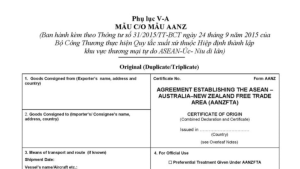
C/O Form AANZ (Certificate of Origin – AANZ Template) is a document certifying the origin of goods under the AANZFTA Agreement. It is used for exports between ASEAN countries, Australia, and New Zealand.
When goods meet the origin criteria under AANZFTA, exporters can declare this certificate during importation to enjoy tariff preferences as agreed in the trade pact.
From April 21, 2025, the AANZFTA Certificate of Origin and related procedures have been updated according to the Second Protocol.
Member Countries of AANZFTA
The AANZFTA includes:
- ASEAN: Brunei, Cambodia, Indonesia, Laos, Malaysia, Myanmar, the Philippines, Singapore, Thailand, and Vietnam.
- Australia and New Zealand.
Goods exported from one member country and imported into another may use C/O Form AANZ, provided they satisfy the required rules of origin and procedural criteria.
>> Read More: Cost-Effective and Comprehensive Cargo Transportation from Vietnam to Cambodia
When Should Exporters Use C/O Form AANZ?
When Should Exporters Use C/O Form AANZ?
Businesses must apply for C/O Form AANZ when exporting goods to AANZFTA member countries — ASEAN, Australia, or New Zealand. Using this form enables goods to benefit from preferential tariff rates, helping reduce import costs and improve competitiveness in partner markets.
However, to be eligible for tariff preferences, goods must fully comply with Rules of Origin (ROO) and the “Direct Consignment” requirement. If goods fail to meet the origin criteria or transit through third countries without valid proof, the preferential tariff under C/O Form AANZ will not apply.
>> Read More: Cargo Insurance Conditions for Import and Export (Updated to ICC 2009)
Key Information on the C/O Form AANZ
Key Information on the C/O Form AANZ
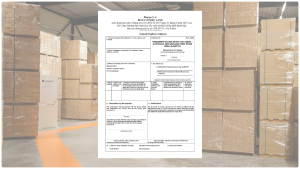
According to the standard format, key fields include:
- Section 1: Exporter information (name, address, country).
- Section 2: Importer or consignee information.
- Section 3: Means of transport, departure date, port of loading and port of discharge.
- Section 4: Reserved for the issuing authority (for official use).
- Sections 5–7: List each product item: item number, marks/number of packages, quantity, product description (including 6-digit HS code, brand if applicable).
- Section 8: Origin-conferring criterion — critical to the form. Examples: “WO” (wholly obtained/produced), “RVC” (regional value content).
- Section 9: Weight/quantity, FOB value (if RVC applies).
- Section 10: Commercial invoice number and date.
- Section 11: Exporter’s declaration confirming that the goods are “produced” in the issuing country and comply with ROO.
- Section 12: Issuing authority certification: date, signature, stamp.
- Section 13: Tick if applicable for special cases such as: “Back-to-Back Certificate of Origin”, “Subject to third-country invoice”, “Issued Retroactively”, “De Minimis”, “Accumulation”.
Rules of Origin (ROO) – What Every Exporter Must Know
The Rules of Origin determine whether goods qualify for tariff preferences under AANZFTA. Common criteria include:
- WO (Wholly Obtained): Goods produced entirely within a member country.
- CTH/CTSH (Change in Tariff Classification): Non-originating materials undergo specific tariff classification changes.
- RVC (Regional Value Content): Minimum regional value threshold must be met.
- PSR (Product Specific Rules): Product-specific rules outlined in the ROO Annex.
- Accumulation: Inputs from multiple AANZFTA members can be counted toward origin value.
Exporters should check the HS code and apply the correct ROO for each product.
Required Documents for C/O Form AANZ Application

Required Documents for C/O Form AANZ Application
Documents:
- Application form for C/O issuance
- Completed C/O Form AANZ
- Copy of export customs declaration
- Commercial invoice
- Bill of lading or relevant transport document
- Supporting origin documents (input–output HS codes, production process, import declarations if applicable)
- Export license (if required)
- Any other documents requested by the issuing authority
Application Procedure for C/O Form AANZ
To ensure smooth and compliant processing, exporters should follow these standardized steps when applying for C/O Form AANZ under the AANZFTA Agreement:
Step 1: Register the Exporter Profile
If this is your first application, register your company information with the authorized issuing body or through the eCOSys system. Registration must include a valid business license, signature specimen, and company seal to verify authenticity for future submissions.
Step 2: Prepare and Submit the Application Dossier
Complete the C/O Form AANZ with accurate details and attach all required supporting documents, including invoices, bills of lading, customs declarations, and origin proof.
Submit the dossier either electronically (via eCOSys) or in person to the designated C/O issuing authority under the Ministry of Industry and Trade (MOIT).
Step 3: Document Verification by the Issuing Authority
The authority will review all submitted documents to ensure consistency and compliance with AANZFTA origin rules.
If discrepancies are found, the applicant may be required to provide additional clarification or supporting evidence. Invalid or incomplete applications will be returned for correction.
Step 4: Official Validation and Approval
Upon successful verification, the officer in charge will record the information into the system, validate the data, and prepare the certificate for signature and stamping by the authorized representative.
Step 5: Issuance and Collection of the Certificate
Once approved, the C/O Form AANZ will be issued, stamped, and signed.
Exporters may collect the physical copy directly or download the certified electronic version, depending on the issuing authority’s system.
Step 6: Recordkeeping and Submission to Importer
Exporters must keep a copy of the issued certificate and send the original (or authenticated e-C/O) to the importer for customs declaration at the destination port.
All related records must be retained for at least 3 years for verification purposes by customs or competent authorities.
Processing Timeline:
Under normal conditions, the certificate should be issued within 3 working days from the export date.
In exceptional cases, the certificate may be issued retroactively (Issued Retroactively) within 12 months from the date of export, subject to justification and approval from the issuing body.
Tip for Exporters:
To minimize delays, ensure all data — especially HS codes, product descriptions, FOB values, and origin criteria — are accurate and consistent across all documents before submission. Inconsistencies between C/O data and customs declarations are among the most common causes of rejection.
Key Compliance Tips for Exporters
Accuracy and consistency across documents are critical. Any errors — HS code, description, FOB value, or origin criterion — can lead to rejection or loss of tariff preference.
Keep track of AANZFTA updates, especially the Second Protocol (2025) version used by many member countries.
Maintain detailed origin records (input materials, import declarations, production processes).
Ensure goods are shipped directly to the importing country; indirect routes must have valid transit proof.
Never alter the C/O after issuance unless officially re-certified.
Strategic Tips to Optimize C/O Form AANZ for Vietnamese Exporters
- Check Product Eligibility: Verify whether your goods qualify under AANZFTA tariff schedules.
- Internal Process Setup: Define a clear workflow — origin verification → document preparation → C/O declaration → submission.
- Digitize Applications: Large exporters should use eCOSys or electronic C/O platforms to save time.
- Stay Updated: Monitor the Ministry of Industry and Trade (MOIT) and Chambers of Commerce for official AANZFTA updates.
>> Read More: What is RCEP? Overview of the Regional Comprehensive Economic Partnership
Cargo Transportation Services to Australia, New Zealand & ASEAN Countries
Cargo Transportation Services to Australia, New Zealand & ASEAN Countries
Applying for C/O Form AANZ is not just a routine customs procedure — it is a strategic step that enables Vietnamese exporters to benefit from preferential tariffs when shipping goods to Australia, New Zealand, and ASEAN member countries under the AANZFTA Agreement.
Even a minor error in documentation — such as incorrect HS code declaration, missing proof of origin, or failure to meet the “direct consignment” requirement — can result in losing tariff incentives, customs clearance delays, or unexpected storage costs.
King Freight Logistics Vietnam (KFLV) offers comprehensive freight forwarding services, ensuring valid documentation, fast processing, and full compliance with regulations issued by the Ministry of Industry and Trade as well as commitments under AANZFTA:
- Consulting and guiding document preparation tailored to product type and destination country.
- Supporting electronic C/O submission through the eCOSys system.
- Optimizing logistics cost and lead time to help exporters fully utilize AANZFTA tariff incentives.
Contact: +84 (0) 938 188 796
Email: cs1@hcm.kfkingfreight.com
KFLV is ready to provide detailed consultation and prompt support — ensuring smooth customs clearance, cost savings, and maximum access to preferential tariffs for your shipments.
Written bykflv.vn
Other activities


Other news

What is a Surrendered Bill of Lading? When Should It Be Used in International Trade? In international shipping, a Bill of Lading (B/L) is not only a transport document but can also function as a document of title to the cargo. However, in many cases businesses do not need this ownership function and choose to […]